

A note for newcomers: Welcome to Family Stuff! My name is Stephanie Murray. I’m a freelance journalist and contributing writer for The Atlantic. Here on Substack, I publish a weekly round-up of newly published research on demography, family policy, and other family stuff. I also publish essays, like this one. If you like my work, please consider becoming a paid subscriber so that I can keep it up!

My favorite part of my job is that I often get to interview people who have dedicated their lives to studying a particular topic. My least favorite part of my job is that I occasionally interview someone for a piece that never makes it to print. That’s what happened a couple of years ago when I interviewed Anna Rotkirch, a research professor & director at Population Research Institute, Väestöliitto, who studies all manner of things related to the baby bust. And that’s a bummer, because it was one of the most interesting interviews I’ve ever done.
(Just in case anyone reading this is unaware, people are having fewer kids these days, both in the U.S. and a whole bunch of other countries. That’s what I’m referring to when I say “the baby bust.” Here is some of my other reporting on this topic, if you’d like to get up to speed. All gift links where relevant.)
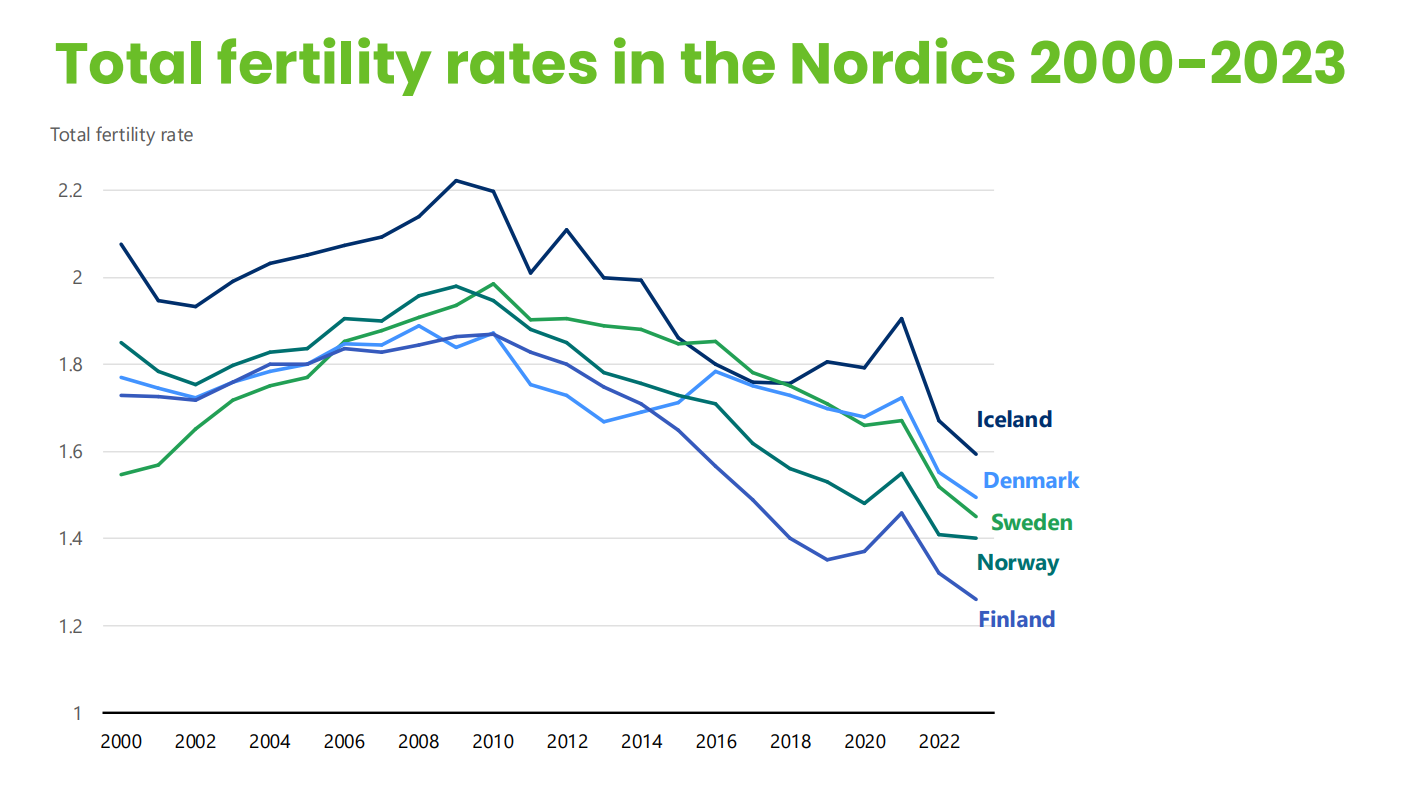
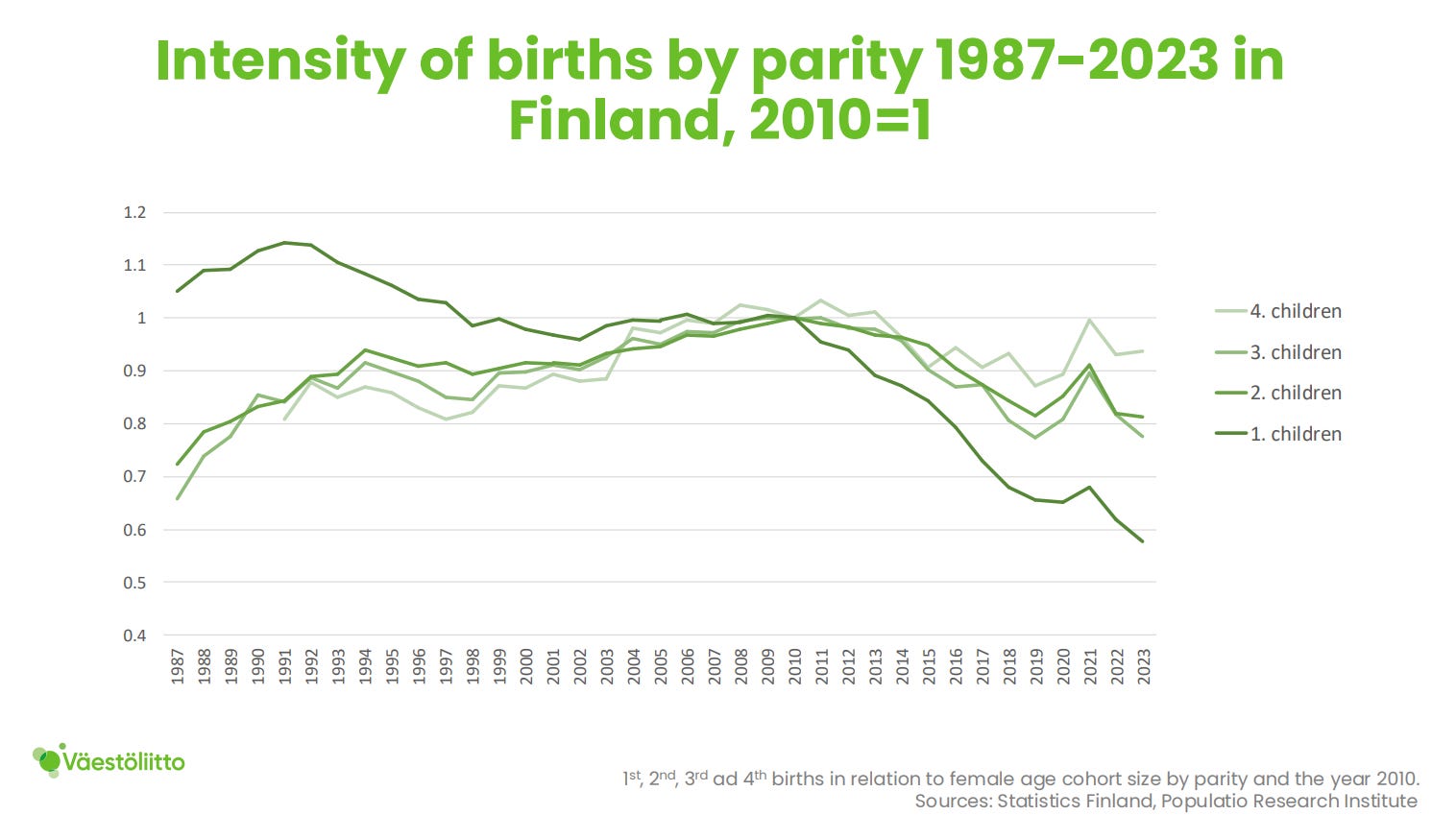
A lot of Rotkirch’s research focuses on Finland, which is something like a poster child for the puzzle of modern fertility decline: the country’s birth rate has utterly tanked in recent years despite the fact that its family policies are quite robust. And the Finnish fertility decline is similar to America’s in that it is primarily driven by first births—that is, by people who are hesitating to become parents, rather than those holding off on having a second or third kid.
For context, I was consulting Rotkirch for a piece about the connection between “uncertainty” and fertility decline. Because it’s very difficult to explain most of the post-Great-Recession baby bust using traditional economic indicators, some researchers are exploring the possibility that more subjective perceptions of uncertainty about the future of the economy and world might be driving births down. The idea is that “you need to have some trust in the future in order to start building a family,” Gunnar Andersson, a professor of demography and head of the Stockholm University Demography Unit (SUDA), told me. Even someone with a solid job may hesitate to have a child if he's convinced a recession—or some other form of societal upheaval—is imminent.
Obviously, economic and political crises aren’t new, but globalization and technological advancement have accelerated the speed at which a disaster—or invention, for that matter—in one country can upend life in another, eroding our sense of insulation from events in far-off places. Smartphones, meanwhile, have heightened our exposure to crises the world over. The unpredictability of the modern day may have had the paradoxical effect of prompting people to try and think ahead, Giammarco Alderotti, a professor of demography at the University of Florence, told me. In other words, in an age of uncertainty, family formation today may be increasingly shaped by our “narratives of the future.”
When I spoke to Rotkirch, however, she expressed a bit of skepticism about that line of thinking. From her view, it isn’t people’s uncertainty about the future of the world that seems the primary culprit, but uncertainty about their desire for kids in the first place. “I think today perhaps the big change is that people are less confident about really wanting a child,” she told me. That’s not to say that people don’t want kids—on average, Finns say they want two children—but that perhaps their commitment to that desire has weakened. As evidence, she pulled up a chart that I have not been able to stop thinking about in the nearly two years since we spoke. It plotted out the share of men and women in Finland who have experienced so-called “baby fever,” or “a strong longing to have a child of your own,” at some point in their lives.